DHS Plumbing · Our specialty
Endless hot water, sized for your house and your water.
The Quality & Integrity You Expect
Tankless rewards doing the job precisely and punishes doing it fast. We size the gas line, plan the vent run, set the condensate, and put you on a descaling schedule built for Sacramento's hard water. Get those right and the unit lasts twenty years.
Free estimate on installation
How it actually works
No tank. It heats the water the moment you ask for it.
A tank keeps forty or fifty gallons hot around the clock, whether you use it or not, and runs out mid-shower once you do. A tankless unit skips the tank entirely.
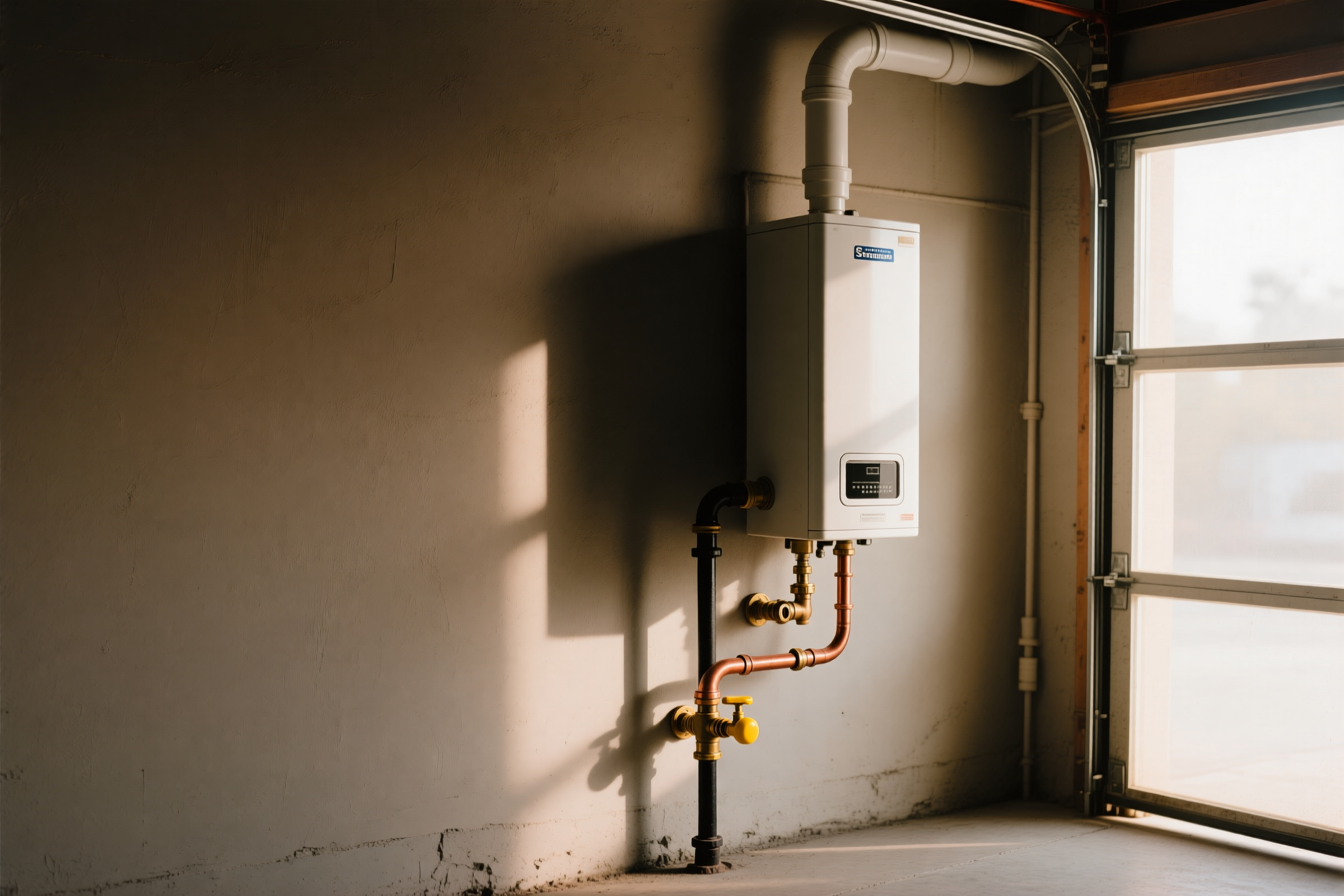
When you open a hot tap, water flows through the unit. A sensor catches the flow, the burner fires, and the water passes through a heat exchanger that raises it to temperature on the way to the faucet. Close the tap and the burner shuts off. Nothing is stored, so nothing runs out.
The whole game is sizing that burner and heat exchanger to your home's real peak demand, in winter, when the incoming water is coldest. Undersize it and you feel it the first cold morning two showers overlap.
What actually changes
Three things you notice after the tank is gone.
Two of these show up on a bill, and one shows up the third time somebody showers before work. Here is the honest version of each, including the part most companies leave out.
- EnergyNo standby loss
- A tank holds forty or fifty gallons at temperature around the clock and reheats them all night, all weekend, and the whole week you were out of town. That is standby loss, and a tankless unit deletes it outright: the burner only fires while water is actually moving. What that saves you depends on your household's habits, your gas rate, and how cold the incoming water runs in January, which is why we won't print a percentage here. We would rather show you the sizing math for your house than a number borrowed from someone else's.
- WaterThe waste is the wait
- Straight answer: switching to tankless does not, by itself, reduce the water you use. What wastes water in most houses is the wait, standing at the far bathroom running cold down the drain until hot finally arrives. In a long single-story layout that is real water, every day, per person. The fix for that is a recirculation line, not the heater, and it is worth asking about while the unit is being planned rather than after. More on that below.
- CapacityFlow rate, not gallons
- A tank has a number, and once you hit it you are done: a cold shower and an hour of waiting for recovery. A tankless unit has no number to hit, because it is limited by flow rate rather than by volume. Back-to-back showers do not run out, and neither does a long one. The real question is not how long you run hot water but how many fixtures run at once, which is exactly what we measure against winter inlet temperature before quoting anything.
Instant hot water
Ask us about a recirculation line.
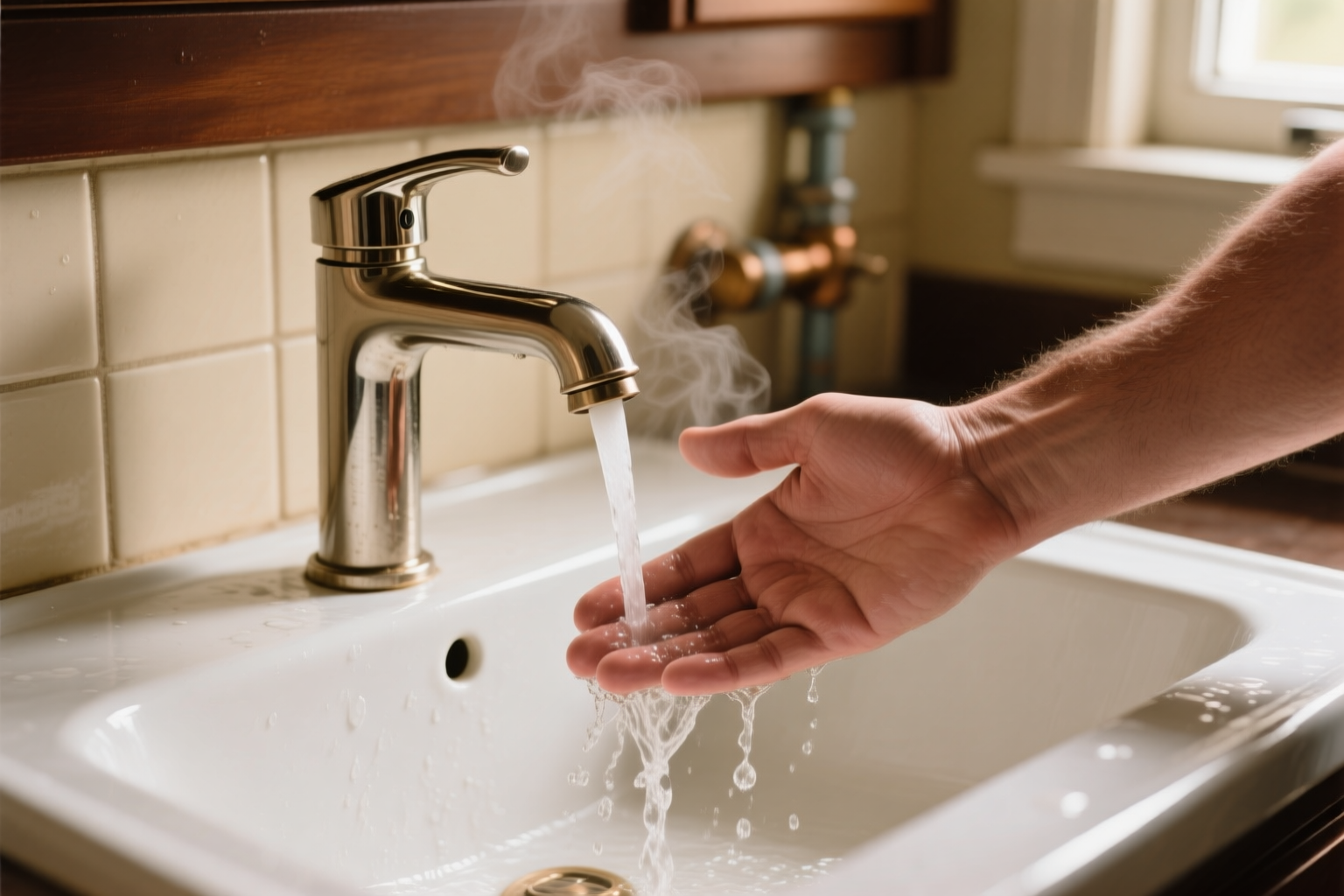
If the wait for hot water at the far end of the house bothers you, say so before we plan the install. Recirculation keeps hot water moving so it is already there when you open the tap, and whether your house can have it, and what it takes, depends on how it was plumbed.
- Already plumbed
- Some homes, more often larger or newer builds, were run with a dedicated hot water return line back to the heater. If yours has one, this is the easy case. Several of the units we install have a recirculation pump and timer built in, so we connect to the existing return and set a schedule that matches when your household actually uses hot water.
- Not plumbed yet
- Plenty of houses here have no return line, and that does not rule recirculation out, it just changes the work. The lighter option is a crossover valve at the farthest fixture, which uses the existing cold line as the return path and needs no walls opened. The thorough option is running a dedicated return line, which is a bigger job and usually only makes sense when walls are already open for a repipe or a remodel.
- How we decide
- We look for an existing return line during the free estimate and tell you which case you are in before you commit to anything. If it is worth doing we will say so, and if the wait at your fixtures is short enough that it isn't, we will say that too.
Recirculation is quoted as its own line item, separate from the install, so you can see what it costs and decide on it independently.
Is it right for your home?
Four questions. A real answer, before we ask for anything.
No email required to see the result. This gets you in the right range so you know what you're looking at. The firm spec still comes from a person at your gas meter.
Answer all four and your range appears here. Nothing is sent anywhere until you choose to send it.
What it costs here
We estimate free. Most companies won't.
The unit itself is usually the smaller part of that number. Two houses on the same street can land at opposite ends for reasons that have nothing to do with the brand either one chose. Here is what actually moves it.
- Gas line sizing
- The single biggest driver. Tankless draws far more gas at peak than a tank, so a line sized for a 40-gallon tank is often undersized. Sometimes just the last run is upsized; sometimes it goes back to the meter.
- The vent run
- A garage unit on an exterior wall vents in a few feet. A unit relocated to an interior closet can need a long run through the attic, which adds both material and labor.
- Condensate
- High-efficiency units make acidic condensate that has to drain somewhere safe. If no drain, pump, or approved outdoor point exists nearby, we add one. That's real plumbing, not an afterthought.
- The permit
- We pull one on every install, and the fee is inside the range, not a surprise. Sacramento, Placer, and El Dorado counties each set their own schedule and inspection timeline.
- Whether a wall opens
- If the gas, vent, or condensate can't route cleanly through existing chases, a wall comes open and gets patched. That's what pushes a job toward the top of the range.
Hard water is the whole game
The unit isn't the problem. The schedule it was never given is.
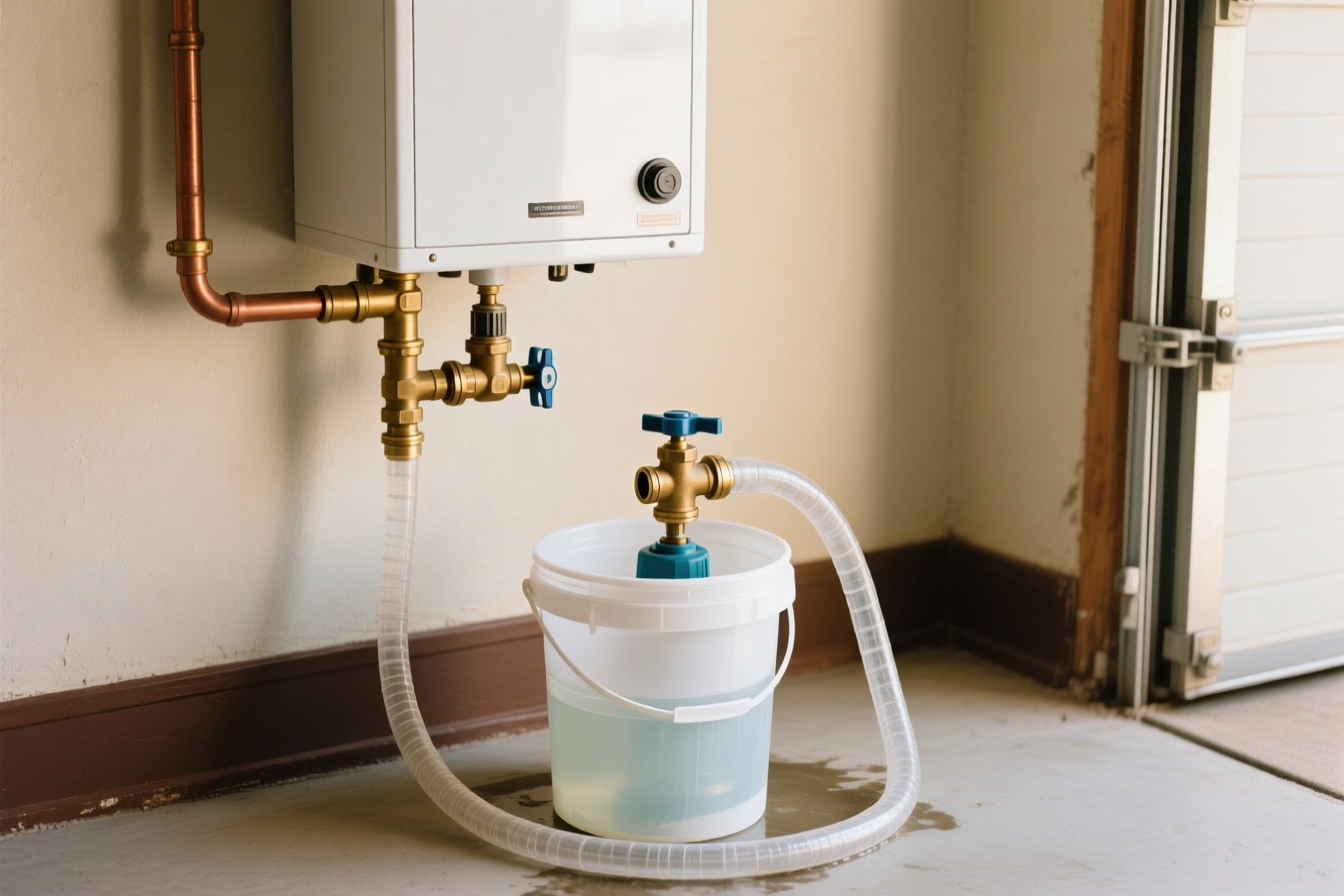
A tankless heater is built to last fifteen to twenty years, but that assumes the water running through it is descaled on schedule. In most of the Sacramento area, that schedule is every 12 to 18 months, tighter than the once-a-year interval printed in most manuals, because our water carries more dissolved calcium and magnesium than the generic recommendation assumes.
Skip it here and a unit that should run twenty years can start throwing error codes, losing flow, or failing outright by year seven or eight. Where you fall in that window depends mostly on how much hot water moves through the unit, so we set the actual next date at the end of every service visit rather than leaving it to memory.
Our maintenance plan puts you on the right interval, documents each descaling to keep your manufacturer warranty valid, and flags early scale before it becomes a failure.
Brands we install
Three units we stand behind, and why.
We're not tied to one manufacturer. We install what fits the house, the demand, and the gas supply. These three earn their place for reasons that show up years after the install.
- NavienCondensing gas
- Our default for most whole-home installs. The dual stainless heat exchangers hold up to our water better than aluminum, and the built-in recirculation option cuts the wait for hot at the far bathroom without a separate pump.
- RinnaiCondensing gas
- The one we reach for when parts availability and long service life matter most. Rinnai's dealer network here is deep, so a warranty part is days away, not weeks, which is the difference that actually shows up when a board fails in year nine.
- NoritzCondensing gas
- Our pick for tighter mechanical closets and retrofit swaps. The compact footprint and flexible venting options let us do a clean install in spaces where the other two would need the wall opened.
Before & after
Same closet. Nothing standing in it.
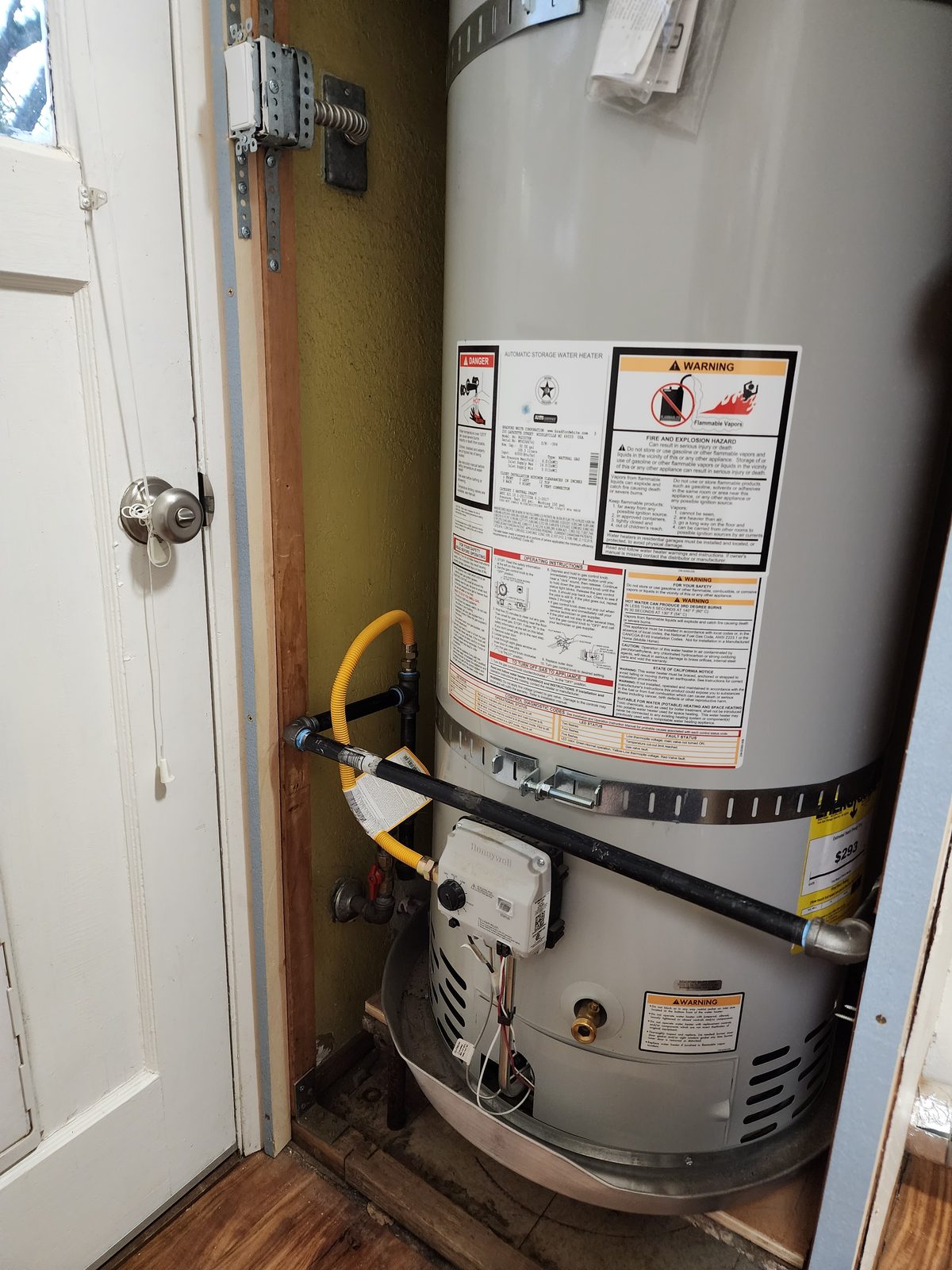
Drag the divider. The tank on the left stood floor to ceiling in a narrow exterior closet and gave you fifty gallons before it quit. The Navien on the right hangs on the back wall of that same closet and never runs out.
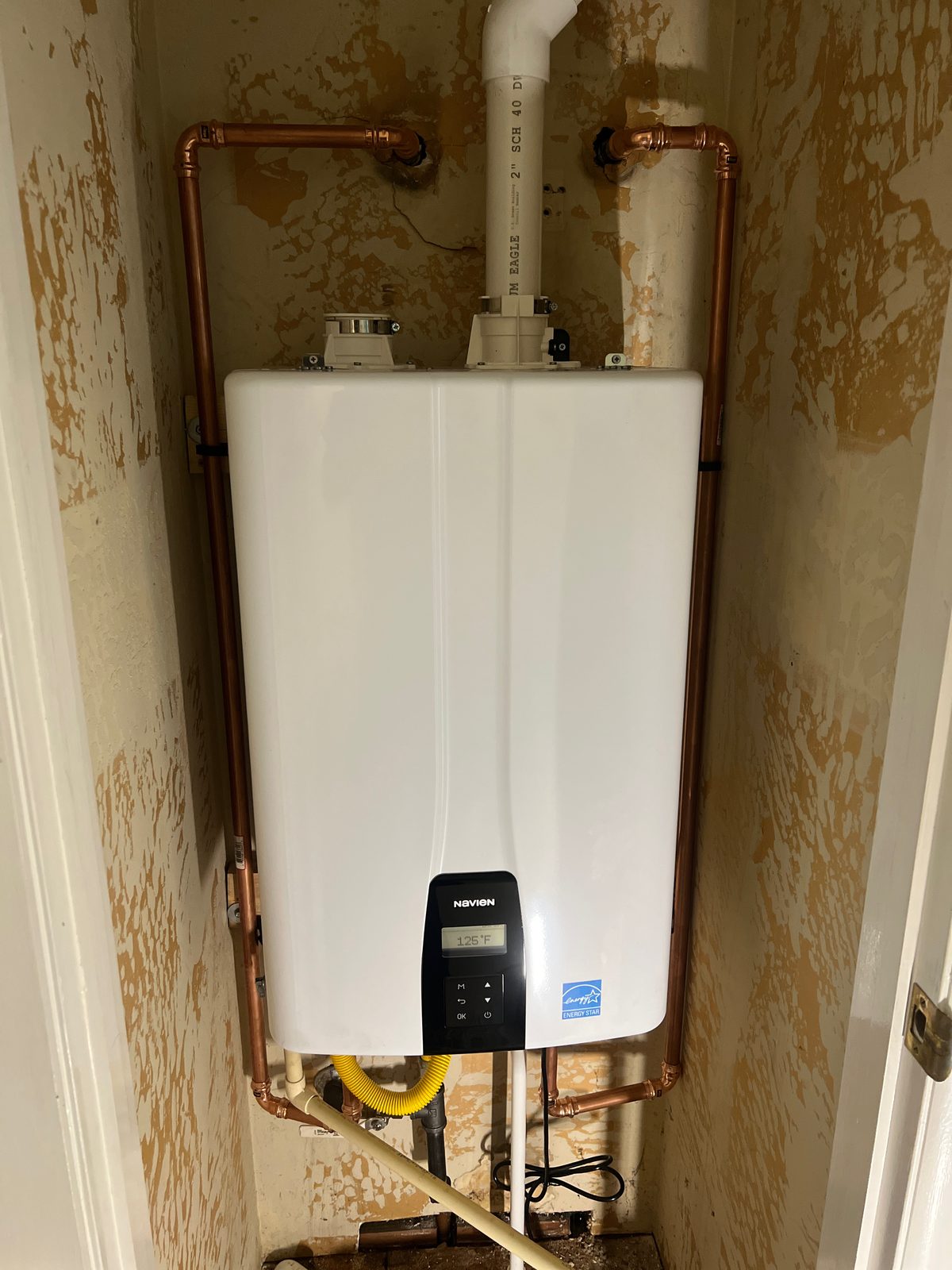 Before
After
Before
After
From tankless customers
Sized right, and it shows.
They were the only company that measured our gas line before quoting. The others just gave a number over the phone. Two winters in, three showers going and the kitchen sink, still never a cold surprise.
Ben walked me through why our old closet swap needed a new vent path instead of just reusing the flue. Nobody had explained it that plainly. The permit and inspection were handled before I even asked.
What sold me was the descaling schedule. They put us on an 18-month reminder and documented it for the warranty. Our last plumber never mentioned hard water once, and that unit died in six years.
Where do you want to go next?
Common questions
The things people ask before they switch.
Installed cost typically is quoted in writing after a free estimate and the unit is the smaller part of that. What moves the number is gas line sizing, the vent run, whether a condensate drain exists, the county permit, and whether a wall has to be opened. We write the number down in front of you after we look, not before.
Every 12 to 18 months, tighter than the annual or gallons-based interval most manuals print, because our water carries more dissolved calcium and magnesium than the generic recommendation assumes. Descaled on schedule, a unit reaches its rated fifteen to twenty years. Skipped, it can start failing by year seven or eight.
For most Sacramento-area homes, yes, if it's sized and maintained correctly. You get endless hot water and a smaller footprint, and a well-kept gas unit lasts nearly twice as long as a tank. The catch is that a fast, undersized install throws away the advantage, which is why we size to your real peak demand and put you on a descaling schedule.
Often, but not always. Tankless vents differently and draws more gas at peak, so the closet needs a code-legal vent path, a condensate drain, and a gas line rated for the unit. Sometimes all three already exist and it's a clean swap. Sometimes the wall opens. We tell you which before you commit.
Every time. An unpermitted gas appliance is a problem at resale and, more urgently, an unpermitted gas connection is a safety question we won't skip. The permit fee is inside the quoted range, not an add-on found later. Sacramento, Placer, and El Dorado counties each run their own schedule and timeline.
For whole-home hot water here, gas. Electric tankless rarely keeps up with a full house against 50-degree winter groundwater without a service-panel upgrade that usually costs more than it saves. Electric can make sense for a single point of use, like a far bathroom or an ADU.
Related reading
Tankless vs. Tank Water Heaters in Sacramento: What Actually Changes on Your Bill
What It Actually Costs to Install a Tankless Water Heater in the Sacramento Area
How Long Does a Tankless Water Heater Last in Hard Water?