01What scale actually does inside the heat exchanger
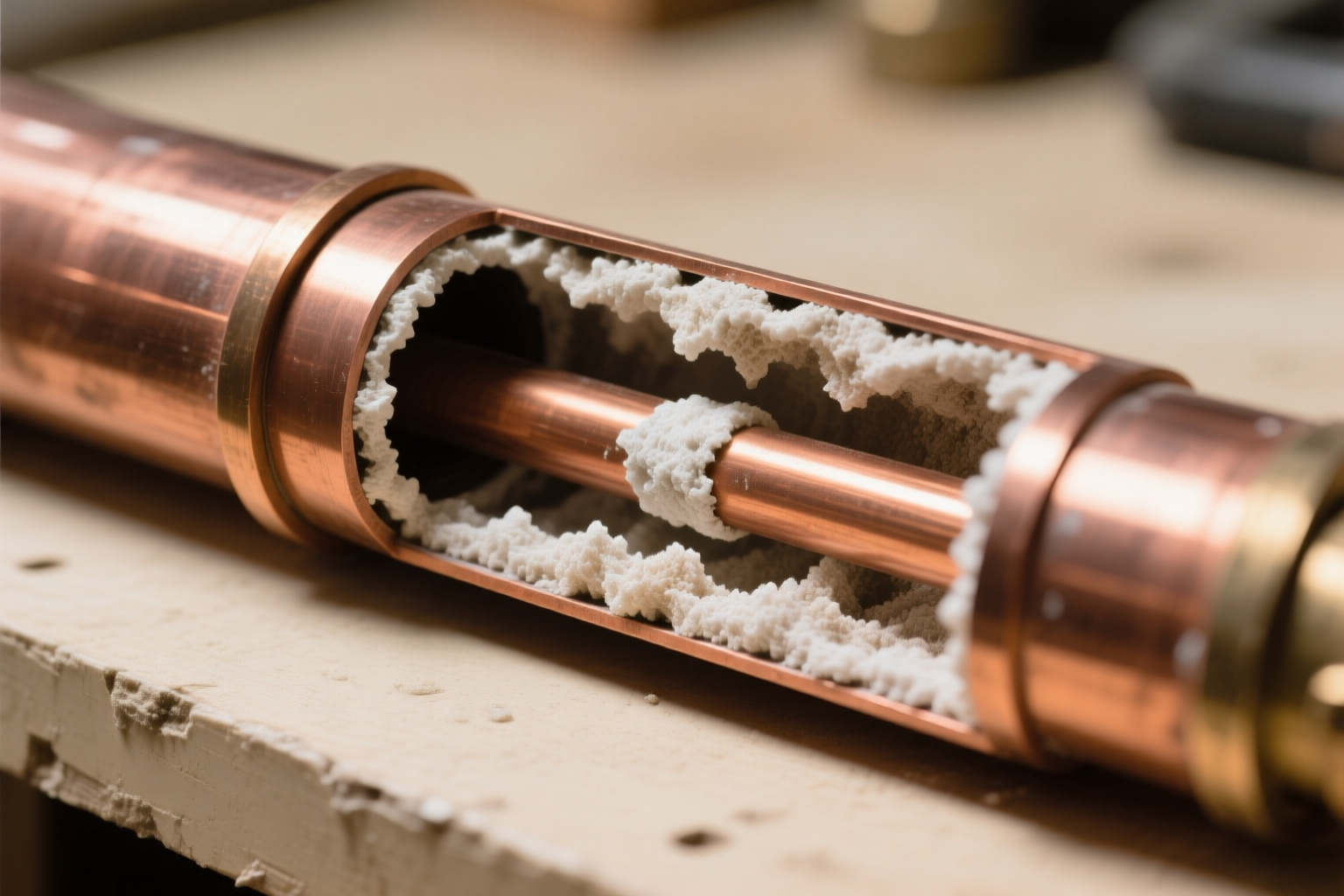
A tankless water heater heats water by running it through a narrow, finned heat exchanger rather than a large open tank. That design is why it's efficient, and it's also why scale is a bigger problem for it than for a tank. Calcium and magnesium dissolved in the water precipitate out onto the hot metal surfaces as the water heats, building a mineral layer inside those narrow passages.
That layer does two things at once. It insulates the exchanger from the water, so the burner has to work harder to reach the same output temperature, and it narrows the passage itself, which reduces flow rate over time. Left long enough, the buildup restricts flow badly enough to trip the unit's own safety sensors, which is usually the first sign a homeowner actually notices.
The rate of buildup isn't linear either. A thin first layer of scale forms relatively quickly once minerals start precipitating, and that rough layer then gives new scale more surface area to cling to, so accumulation tends to accelerate the longer it goes unaddressed. That's part of why waiting an extra year past a reasonable descaling interval does more damage than skipping the first year alone would suggest.
This is different from what happens in a tank, where sediment settles to the bottom and mostly stays out of the way of the water above it. A tankless exchanger has no bottom for scale to settle into. Every bit of buildup sits directly in the path the water has to pass through, which is the structural reason tankless units are more sensitive to hard water than tank units, not a flaw in the design.
02Why Sacramento's water is tougher on it than the manual assumes
Manufacturer descaling recommendations are written for a wide range of water conditions, often defaulting to moderate hardness or a generic annual interval. Water across the Sacramento region runs harder than that baseline in most of the communities we serve, and the exact hardness varies somewhat by district within Sacramento, Placer, and El Dorado counties. We cover the water chemistry itself in more depth in what Sacramento's water does to your plumbing, but the practical takeaway here is simple: a schedule built for softer water elsewhere will let scale accumulate faster than it should in most homes we service.
This matters most for homes that never had the descaling conversation at all, which is common with units installed by a general contractor as part of a larger remodel rather than a tankless specialist. The unit works fine for years, so nobody thinks about it, and the manual's own interval quietly passes without anyone noticing, since there's no dashboard warning light for accumulated scale the way there is for a low battery.
03The real descaling interval here, against the generic advice
Where a manual might suggest annual service or a service interval tied to gallons processed, we put tankless units in this region on a 12 to 18 month descaling schedule as the honest default, tightening that further for households with heavier hot water use or a unit that's already showing early scale symptoms. That's not us being conservative for the sake of it. It's the interval that actually matches what we see when we open up units that were serviced on the generic schedule instead: measurable scale buildup well before the manual's own next-service date.
Where a household falls in that 12 to 18 month range depends mostly on how much hot water moves through the unit. A large family running multiple showers daily and a dishwasher every night is closer to the 12 month end. A smaller household with lighter use can often reasonably stretch toward 18 months. We set the actual date at the end of each service visit rather than leaving it to memory, which is the single easiest way we've found to keep a household from accidentally sliding past the window.
We can check flow and scale in one visit
A quick check tells us whether you're due now or genuinely have time before the next service.
Book an Appointment04Warning signs you waited too long
A handful of symptoms show up consistently in units that have gone past their descaling window. Water temperature that drifts or fluctuates during a shower, rather than holding steady, is often an early one. A noticeable delay before hot water arrives, longer than the unit showed when new, is another. An error code referencing flow or temperature sensing is a more serious one, and it usually means scale has already narrowed the exchanger enough to affect performance, not just efficiency.
None of these symptoms are exclusive to scale, which is why we look at the unit directly rather than guessing from a phone description. But in our experience, a unit showing two or more of these at once, and more than 18 months since its last descaling, is scale until proven otherwise.
A rising gas bill without an obvious change in household habits is a subtler sign worth mentioning too. Since scale forces the burner to work harder for the same output, a unit that's quietly losing efficiency to scale buildup can show up on the utility bill before it ever throws a code or noticeably changes how the shower feels.
A ticking or knocking sound from the unit during operation is worth flagging as well. It isn't present in every case, but when it shows up alongside a delayed hot water start or a fluctuating temperature, it's often scale affecting how evenly water moves through the exchanger's internal passages.
05What's actually on the line
Manufacturer equipment warranties on tankless units typically run five to fifteen years depending on the unit, and most of those warranties require documented maintenance to stay valid, descaling included. A unit maintained on schedule can reasonably be expected to reach the upper end of its rated service life. A unit that skips descaling for years at a time is gambling that same lifespan against a mineral layer that only gets harder to remove the longer it sits. The math is straightforward: an hour of descaling every 12 to 18 months is a small, predictable cost against replacing the whole unit years ahead of schedule.
There's also a documentation side to this that's easy to overlook. If a unit ever needs a warranty claim, having service records showing descaling was performed on schedule is often the difference between the manufacturer honoring the claim and denying it for lack of proof. We log the date and findings of every descaling visit for exactly this reason, and we'd encourage anyone doing the work themselves to keep a simple written record too.
06Frequently asked questions
Every 12 to 18 months, tighter than the generic annual interval most manuals print. Heavier hot water use pushes you toward the 12-month end; a smaller household with lighter use can often reasonably stretch toward 18.
Water temperature that drifts during a shower, a longer delay before hot water arrives, an error code referencing flow or temperature, a rising gas bill with no change in habits, or a ticking or knocking sound during operation. Two or more of these, past 18 months since the last descaling, is scale until proven otherwise.
A tank lets sediment settle to the bottom, out of the water's path. A tankless heat exchanger has no bottom for scale to settle into, so every bit of buildup sits directly where the water has to pass through, insulating the exchanger and narrowing flow at the same time.
Yes. Warranties, typically five to fifteen years, usually require documented maintenance, descaling included, to stay valid. We log the date and findings of every visit for exactly this reason, and recommend anyone doing it themselves keep a written record too.